
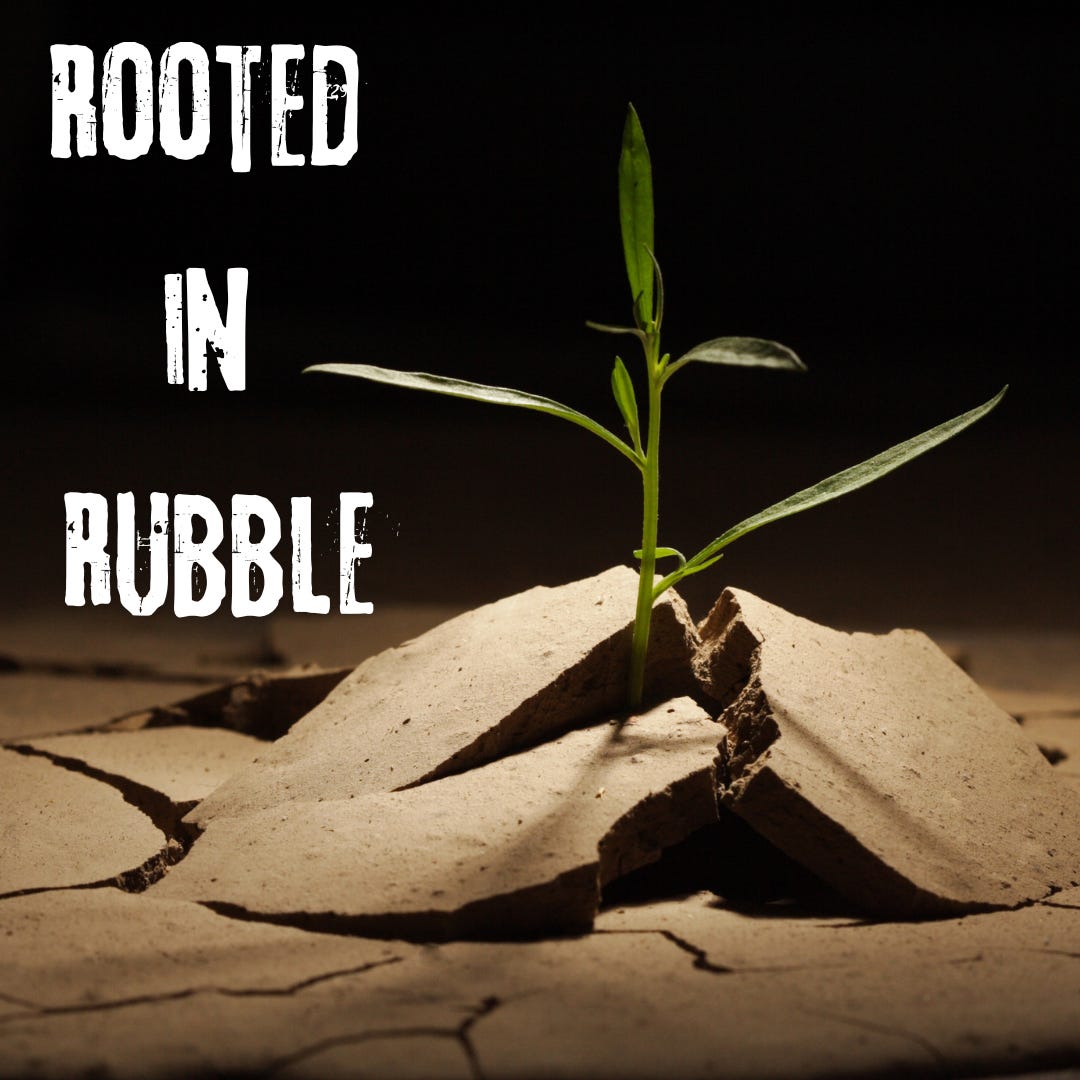
Rooted in Rubble
Nine things we can do in a time of rapid change

The other day my daughter asked me a question that stopped me in my tracks.
“Dad, are we heading for war?”
How do you answer a question like that?
My mind was already spinning. Climate emergency. Rapid shifts in technology and AI. The rise of the far right. The sense that the ground beneath our feet is moving faster than we can keep up with. Systems that once felt stable now feel brittle. Promises we were told would hold no longer do.
And then a child asks the question out loud.
I didn’t want to brush it off. I didn’t want to offer false reassurance. I also didn’t want to hand her my anxiety, half-formed and heavy.
What I felt underneath her question, and underneath my own restless thinking, was something simpler and harder to answer:
What can I do?
What can we do?
I keep coming back to this conviction: that while we cannot control the scale or speed of the changes unfolding around us, we are not powerless. There are ways of living, preparing, and rooting ourselves that don’t begin with panic or withdrawal, but with attention, skill, and community.
The list I’m working with over the next nine weeks is adapted from the thinking of Bill Mollison, the co-founder of permaculture. Permaculture is not just a way of gardening, but a design approach for human life rooted in how natural systems actually work. Mollison spent much of his life asking a simple, demanding question: how might ordinary people live well as extractive systems begin to fail? His response was never fear or escape, but learning practical skills, building local resilience, caring for land, and strengthening community. I’ve reworked his ideas for the realities of climate emergency and rapid change today, and added one further point around the importance of spiritual community.
This series isn’t about survivalism.
It isn’t about escaping the world.
It isn’t about having all the answers.
It’s about rooting ourselves in a time of rapid change, and asking what kinds of lives, communities, and practices are worth building now.
Here are the nine things I want to explore. I’ll return to each one in more depth over the coming weeks.
Learning to plant not just gardens, but food and trees that sustain life
Forming real bonds with land and place
Developing practical skills and sharing them with others
Building mutual support communities that care for one another
Simplifying our lives to free time, energy, and attention
Stepping away from endless consumption and choosing what lasts
Saving, sharing, and spreading native, living seeds
Trusting that this moment is a transition, not the end of the story
Creating spiritual communities that sustain both inner and outer life
These are not quick fixes. They are not grand strategies. They are small, grounded, human responses to a world under pressure.
When my daughter asks me about war, about fear, about the future, I want to be able to say something honest. Not just with words, but with the way we live.
This series is my attempt to keep answering that question, week by week.
What can we do?
We can root ourselves.
We can learn.
We can prepare together.